Oxygen Under Pressure: The Promise and the Politics of HBOT for Brain Injury
Reviewed for accuracy by Strength in Pain Foundation team. This article is educational and is not medical advice — talk with a qualified hyperbaric physician or provider familiar with brain injury before beginning any treatment.
Does insurance cover HBOT for brain injury?
No — in most cases. The FDA has approved hyperbaric oxygen therapy for 13 conditions, including diabetic wounds and carbon monoxide poisoning, and insurers typically cover those. Traumatic brain injury is not on that approved list, so Medicare, Medicaid, and most private insurers deny HBOT coverage for TBI as "not medically necessary" or "experimental" — despite growing peer-reviewed evidence and a well-established safety record. Survivors are often left paying $200–$300 per session out of pocket, with a full course typically requiring 40 or more sessions. This gap in coverage, not the science itself, is the central barrier to access.
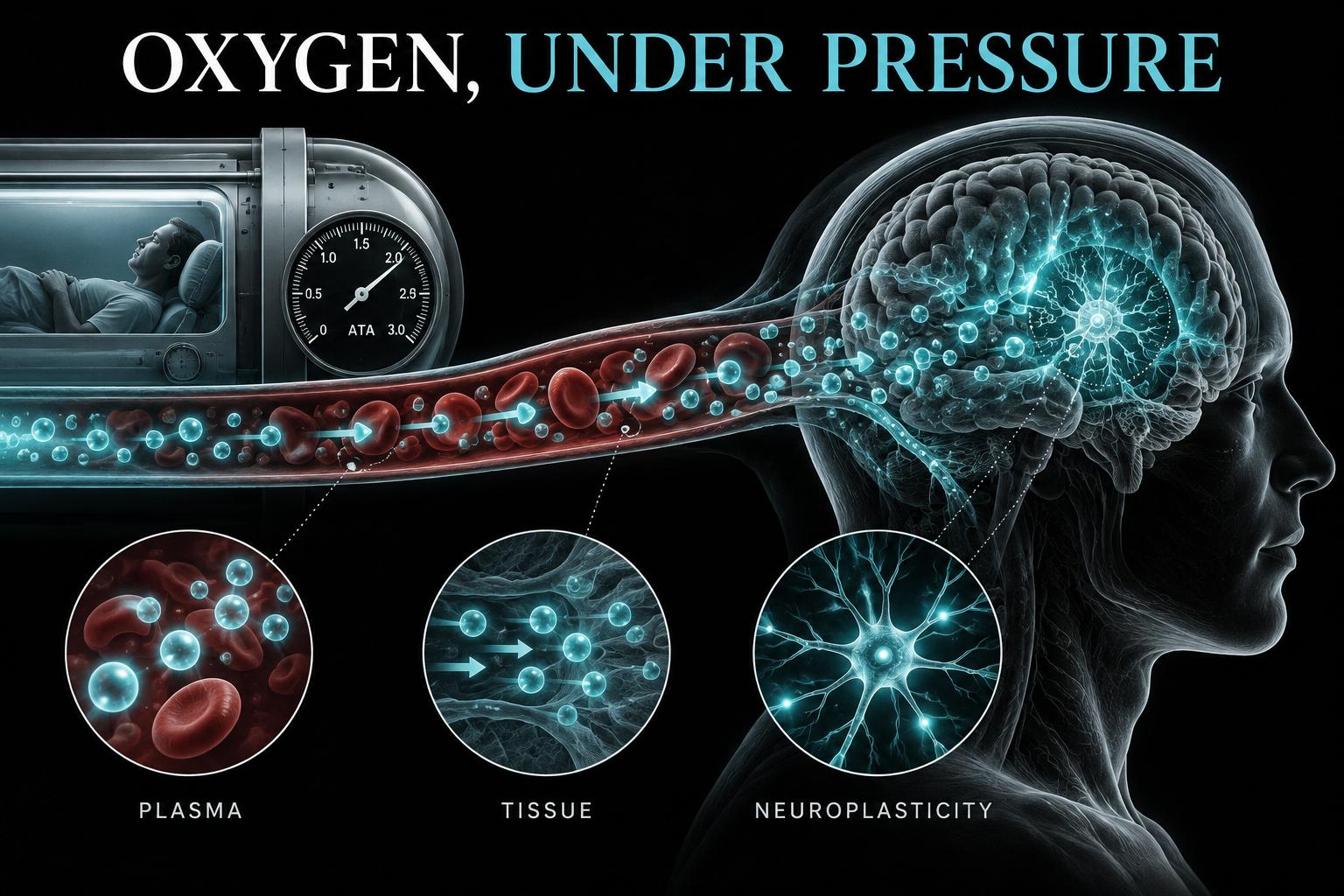
Hyperbaric oxygen therapy — commonly known as HBOT — is a medical treatment in which a patient breathes 100% pure oxygen inside a pressurized chamber, typically at pressures between 1.5 and 3 times normal atmospheric levels. Under these conditions, oxygen dissolves directly into the blood plasma, cerebrospinal fluid, and lymph fluid at concentrations far exceeding what is possible through normal respiration, allowing it to reach tissues where blood flow may be compromised. Our founder's own single-session breakthrough with HBOT is described in Bjorn's story.
The core physiological effects include increased oxygen delivery to damaged tissues, reduction of inflammation, stimulation of stem cell mobilization, acceleration of collagen synthesis, and promotion of angiogenesis — the growth of new blood vessels. For brain injury survivors, the most promising mechanism is neuroplasticity: the brain's ability to rewire itself and form new neural pathways, a process that oxygen-rich environments appear to support.
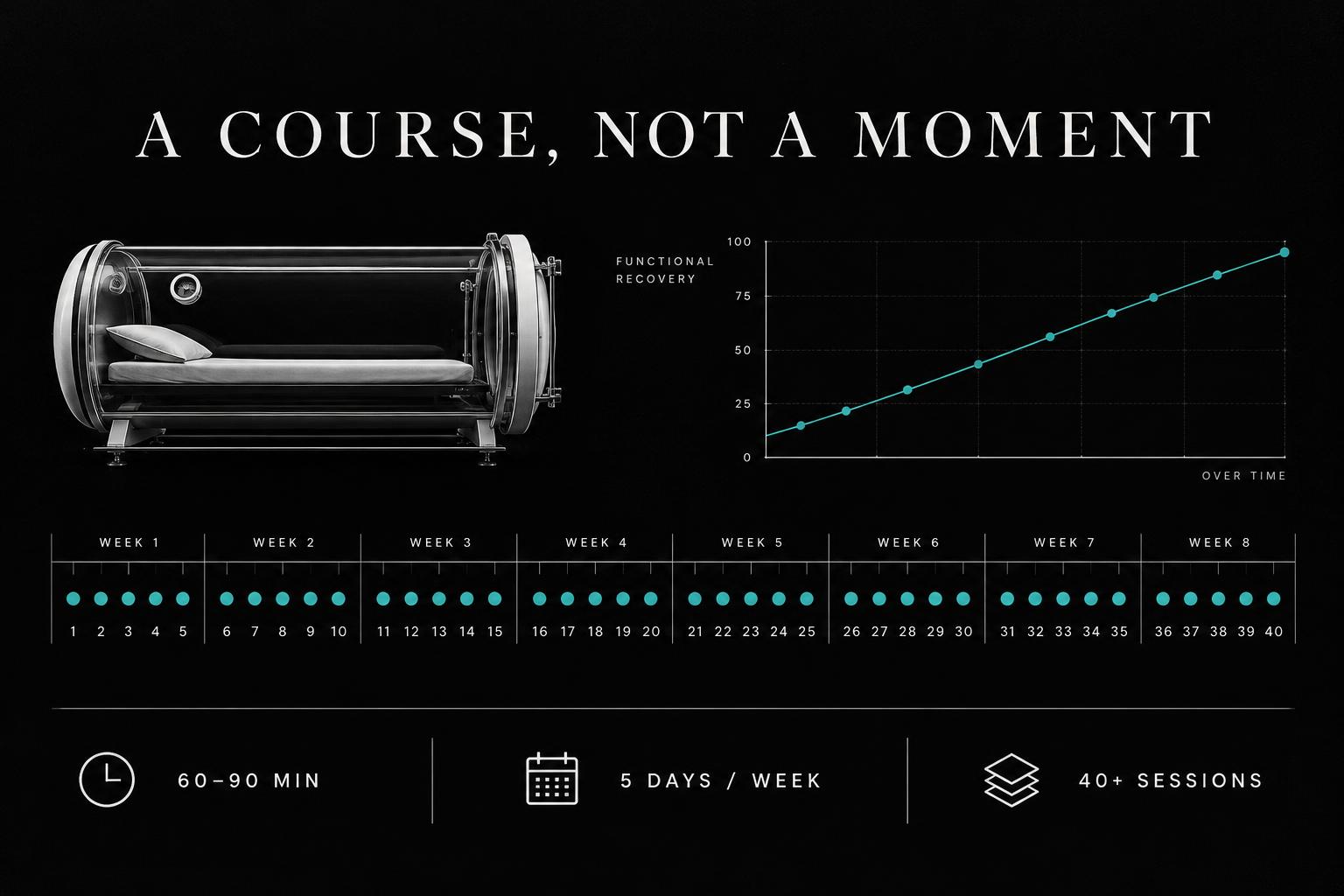
Sessions typically last 60 to 90 minutes and are conducted in either a monoplace chamber (a single-person tube) or a multiplace chamber that can accommodate several patients at once. A course of treatment for brain injury generally involves 40 or more sessions, often administered five days per week over several weeks.
A Brief History of HBOT
The concept of pressurized environments as a medical tool is far older than most people realize. Its roots stretch back to the 17th century, when British physician Nathaniel Henshaw constructed what he called a "domicilium" — a sealed chamber with manually controlled air pressure — believing that different pressures could treat various ailments. Though primitive by any modern standard, it was a conceptual precursor to everything that followed.
In 1834, French physician Junod constructed a hyperbaric chamber and treated patients — the first structured therapeutic application of pressurized air. Through the 1860s–1880s, hyperbaric chambers proliferated across Europe and North America, used broadly for everything from anemia to nervous disorders. In 1878, French physiologist Paul Bert published La Pression Barometrique, establishing the scientific foundation for understanding oxygen toxicity and decompression illness.
By the 1950s and 1960s, HBOT entered mainstream medicine. Dutch cardiac surgeon Ite Boerema began using HBOT during open-heart surgery, and his landmark 1960 paper "Life Without Blood" demonstrated that pigs could survive at extremely low hemoglobin levels breathing hyperbaric oxygen. HBOT became the standard of care for carbon monoxide poisoning and decompression sickness, and the Undersea and Hyperbaric Medical Society (UHMS) was founded in 1967.
In the decades since, the FDA and UHMS approved HBOT for a growing list of conditions: radiation tissue damage, chronic non-healing wounds, necrotizing infections, and others. More recently, military medicine has become a major driver of TBI-related HBOT research as veterans returned from Iraq and Afghanistan with blast-induced traumatic brain injuries, launching dozens of clinical trials.
How HBOT May Help Brain Injury Survivors
Traumatic brain injury — whether from a car accident, a fall, a sports collision, or a combat blast — disrupts the brain's delicate metabolic balance. In the acute phase, swelling, bleeding, and oxygen deprivation can kill neurons outright. But the damage doesn't stop there. In the weeks, months, and even years that follow, injured tissue in a state of "metabolic coma" — still alive but functionally dormant — continues to affect cognition, mood, sleep, and physical function.
This is where HBOT's proposed mechanism becomes particularly compelling. Neuroimaging studies using SPECT (single-photon emission computed tomography) have documented increased blood flow and metabolic activity in previously dormant brain regions following a course of hyperbaric oxygen treatment. The hypothesis is that chronically under-oxygenated tissue — the so-called "ischemic penumbra" — can be reactivated when oxygen levels are raised sufficiently and consistently.
Beyond oxygen delivery, HBOT triggers a cascade of biological responses: it reduces neuroinflammation, promotes the release of vascular endothelial growth factor (VEGF), stimulates stem cell mobilization from bone marrow, and may support the repair of myelin — the protective sheath surrounding nerve fibers that is often damaged in TBI.
Reported improvements in TBI survivors undergoing HBOT include reduced headache frequency and severity, improved cognitive function, memory and processing speed, reduced symptoms of PTSD, better sleep quality and reduced fatigue, improved balance and motor coordination, reduced anxiety and depression symptoms, greater emotional regulation and reduced irritability, and improved quality of life and ability to return to work.
The Research Landscape
The scientific literature on HBOT for TBI is genuinely complex — a fact that advocates and skeptics alike tend to simplify in ways that serve their respective positions. The honest picture is this: there is meaningful, growing evidence that HBOT can benefit TBI survivors, and there are also legitimate scientific disputes about study design, patient selection, and the interpretation of results.
Key studies have included work by Israeli researchers Dr. Shai Efrati and colleagues, whose randomized controlled trials showed statistically significant improvements in cognitive function and quality of life in post-concussion patients treated with HBOT — even years after the original injury (Efrati et al., PLoS ONE, 2013). Military-funded research at Brooke Army Medical Center has similarly shown benefit in veterans with blast-induced TBI. Many survivors pair HBOT with other neuroplasticity-driven approaches, including neurofeedback for TBI survivors, which may work synergistically with hyperbaric oxygen.
A 2012 Department of Defense-funded multi-site trial — the HOPPS/BIMA line of studies, reported by Wolf et al. and Cifu et al. — produced more ambiguous results, with improvements seen in both the treatment group and the sham-pressure control group, leading some researchers to question whether the effects were real or artifactual. HBOT advocates argue that this study used inadequate pressure protocols and mixed TBI with PTSD patients in ways that muddied the results. The debate has not been resolved; full citations are listed in the resources section below.
What is not in serious dispute is that HBOT is safe when administered by trained professionals, has a well-established track record for its approved indications, and that the biological mechanisms by which it might help injured brains are scientifically plausible. The question is one of evidence grade — and that question is being used, by insurers, as grounds for blanket denial.
The Insurance Coverage Crisis
Here is where the story becomes not just scientific but deeply human and deeply unjust. The U.S. Food and Drug Administration has approved HBOT for 13 medical conditions, including diabetic foot ulcers, radiation tissue damage, carbon monoxide poisoning, and decompression sickness — see the FDA's list of approved HBOT indications. For these indications, most major insurers will cover treatment. Traumatic brain injury is not on that list — and that absence is costing survivors their health, their livelihoods, and sometimes their lives.
Major insurance carriers including Medicare, Medicaid, and most private health plans deny HBOT for TBI on the grounds that it is "not medically necessary" or is "investigational/experimental" — despite a growing body of peer-reviewed evidence to the contrary and widespread use in clinical settings around the world.
The FDA's 13 approved indications for HBOT were established largely between the 1960s and 1990s, when the evidentiary bar and bureaucratic process were quite different. Getting a new indication formally approved through the FDA requires a pharmaceutical-style clinical trial process that costs tens of millions of dollars — investment that the hyperbaric industry, largely composed of hospital departments and small clinics, cannot easily marshal. No pharmaceutical company has a financial incentive to fund the trials because HBOT cannot be patented. The result is a Catch-22: insurers demand the evidence grade that only large trials can produce, and large trials cannot be funded because no one profits from the approval.
This dynamic is not unique to HBOT, but its consequences for brain injury survivors are particularly acute. Unlike a diabetic foot wound, which can be visually assessed, TBI manifests in invisible ways — cognitive fog, personality changes, chronic pain, depression, sleep disruption — that are difficult to quantify and easy for insurers to dismiss as "subjective."
Meanwhile, survivors who can afford to pay out of pocket — typically $200 to $300 per session as of 2026, with a minimum of 40 sessions recommended, so roughly $8,000 to $12,000 for a full course — are accessing treatment and reporting transformative results. Costs vary by region and chamber type and do shift over time, so confirm current pricing with any clinic directly. Those who cannot afford it are left to manage with symptom-suppressing medications, limited physical therapy coverage, and the profound isolation that comes from an injury that no one can see. The Foundation's Financial Assistance Program exists specifically to help close that gap for California TBI survivors.
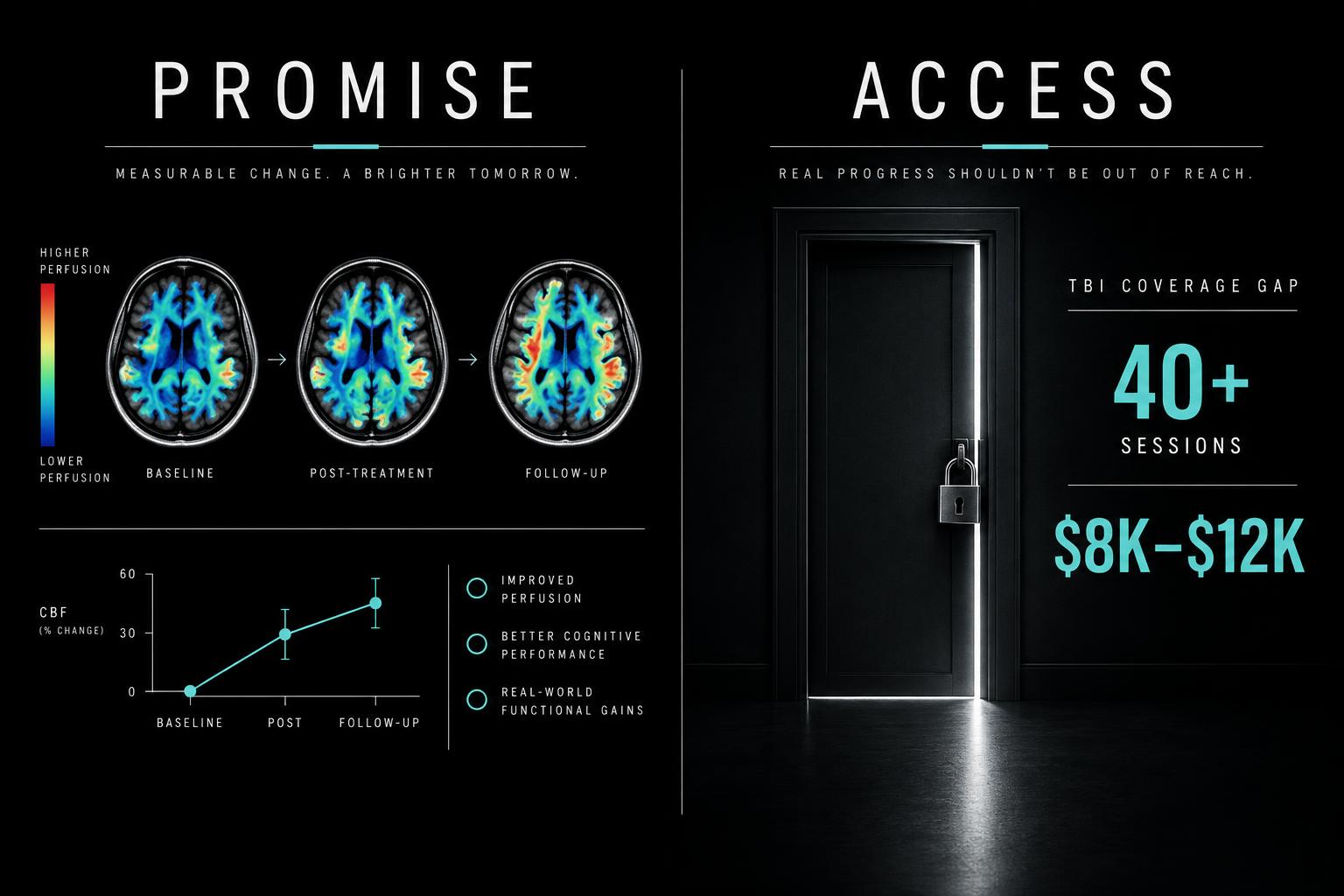
The class dimensions of this disparity are impossible to ignore. Wealthy TBI survivors can pursue dozens of sessions and emerge with measurably improved neurological function. Lower-income survivors — who are statistically more likely to have sustained TBI through workplace accidents, vehicle crashes, and domestic violence — are denied the same opportunity entirely.
The Human Cost of Denial
Behind every insurance denial is a person — and behind that person is a family, a job that may be lost, a life that has been fractured by an injury that the rest of the world cannot see. The human cost of the insurance coverage gap for TBI plays out in foreclosed homes, ended marriages, careers terminated, and the quiet despair that comes from being told that a treatment that could help you is simply unavailable to you.
TBI survivors dealing with denied HBOT coverage frequently describe an exhausting appeals process that requires them to navigate complex bureaucracies at the precise moment when their cognitive capacity is most impaired. Many give up. Those who persist often encounter repeated denials, each requiring more documentation, more specialist letters, more time.
The financial strain of out-of-pocket treatment is itself a health threat. Stress, financial precarity, and reduced access to other forms of care compound the neurological effects of the original injury. Survivors who forego treatment entirely may plateau at a level of impairment that is not inevitable — that could, with access to appropriate care, be substantially improved.
What Advocates Are Doing
The movement to expand insurance coverage for HBOT in TBI is growing, driven by a coalition of patient advocates, military veteran organizations, neurologists, and nonprofits who recognize that the status quo is both scientifically unjustified and morally untenable.
Key advocacy strategies being pursued include lobbying at state and federal levels for legislation mandating TBI-related HBOT coverage, supporting peer-reviewed research through foundation grants and academic medical center partnerships, sharing survivor stories publicly to build political will for coverage reform, connecting survivors with appeals resources and pro bono assistance to challenge denials, engaging city and county governments to create locally funded access programs, partnering with veterans' advocacy organizations, and working with hyperbaric facilities to develop sliding-scale and grant-funded access for low-income survivors.
Veterans' groups have been particularly effective advocates because of the visibility of combat-related TBI, the credibility of military research institutions, and the political leverage of organizations like the Veterans of Foreign Wars and the American Legion. Progress in veteran coverage has been incremental but real — and advocates hope that precedents set in the VA system will eventually influence private insurance policy.
What You Can Do
The gap between what HBOT can offer TBI survivors and what the insurance system will pay for is not a scientific problem. It is a political and economic one — and that means it is, ultimately, a problem that organized advocacy can solve. If you are a TBI survivor, a caregiver, a healthcare provider, or simply someone who believes that access to potentially life-changing treatment should not depend on the size of your bank account, there are meaningful actions you can take.
Contact your congressional representatives and ask them to support legislation expanding Medicare and Medicaid coverage of HBOT for TBI. Share your story or the story of a survivor you know — personal testimony is among the most powerful tools in advocacy. Support nonprofit organizations working at the intersection of TBI advocacy and HBOT access, including our own patient advocacy work and financial assistance for treatments insurance won't cover. If you have been denied coverage, request a written explanation and consider filing a formal appeal — many denials are reversed with proper documentation. Ask your state insurance commissioner's office whether your state has enacted or is considering HBOT coverage mandates. If you are a healthcare provider, document your patients' responses to HBOT and contribute to the evidence base through case reporting and clinical trial participation.
For background on the therapies survivors most often combine with hyperbaric oxygen, see our free concussion and TBI recovery guides and the brain recovery toolbox section covering HBOT, neurofeedback, and photobiomodulation, plus our review of supplements and biohacking for brain injury recovery.
The brain is the seat of everything we are — our personalities, our memories, our capacity to connect with the people we love. Injuries to the brain are injuries to the self. The least we can do, as a society, is ensure that survivors have access to every credible tool available for recovery — not just the ones that happen to be profitable enough to attract insurance approval.
HBOT is not a miracle cure. It is not effective for every patient, and it is not a replacement for comprehensive rehabilitation. But for the survivors for whom it works — and the evidence suggests that is a meaningful number — it can be the difference between a life of managed decline and a genuine return to function. That possibility should not be a privilege. It should be a right.
FAQ: HBOT for Brain Injury
Does insurance cover HBOT for traumatic brain injury?
Usually not. TBI is not among the FDA-approved indications for hyperbaric oxygen therapy, so Medicare, Medicaid, and most private insurers deny it as "not medically necessary" or "experimental." Denials can be appealed, and appeals are sometimes successful with strong physician documentation, but most survivors currently pay out of pocket.
How much does HBOT cost for concussion recovery?
As of 2026, sessions typically run $200 to $300 each, and brain injury protocols commonly call for 40 or more sessions — roughly $8,000 to $12,000 for a full course. Pricing varies by region, chamber type, and clinic, so confirm current rates directly.
Is HBOT FDA approved for TBI?
No. The FDA has approved HBOT for 13 conditions, including decompression sickness, carbon monoxide poisoning, diabetic wounds, and radiation tissue injury. Traumatic brain injury is not on that list, which is the basis insurers cite when denying coverage — not a finding that HBOT is unsafe.
How many HBOT sessions are needed for a brain injury?
Most brain injury protocols involve at least 40 sessions of 60–90 minutes, often five days per week over several weeks. Some survivors continue with maintenance sessions afterward based on their response.
Is HBOT safe?
When administered by trained professionals in a proper chamber, HBOT has a well-established safety record. The most common side effects are ear and sinus barotrauma from pressure changes and temporary vision changes; serious complications such as oxygen toxicity are rare with standard protocols.
Does the research actually show HBOT works for TBI?
The evidence is promising but contested. Randomized trials from Efrati and colleagues showed cognitive and quality-of-life gains in chronic post-concussion patients, while the Department of Defense-funded multi-site trials found improvement in both treated and sham-pressure groups. The scientific debate is about study design and evidence grade, and it remains unresolved.
Can HBOT be combined with other TBI therapies?
Yes, and it commonly is. Survivors frequently pair HBOT with neurofeedback, vestibular and cognitive rehabilitation, and nutritional support. Coordinate the full plan through one provider so responses can be tracked and attributed.
Resources & Further Reading
FDA approved uses: U.S. Food and Drug Administration, "Hyperbaric Oxygen Therapy: Get the Facts" — the agency's list of the 13 cleared indications.
Efrati S, Fishlev G, Bechor Y, et al. "Hyperbaric oxygen induces late neuroplasticity in post stroke patients — randomized, prospective trial." PLoS ONE, 2013.
Boussi-Gross R, Golan H, Fishlev G, et al. "Hyperbaric oxygen therapy can improve post concussion syndrome years after mild traumatic brain injury — randomized prospective trial." PLoS ONE, 2013.
Wolf G, Cifu D, Baugh L, Carne W, Profenna L. "The effect of hyperbaric oxygen on symptoms after mild traumatic brain injury." Journal of Neurotrauma, 2012 — the Department of Defense-funded multi-site trial in which both treatment and sham-pressure groups improved.
Cifu DX, Hoke KW, Wetzel PA, et al. "Effects of hyperbaric oxygen on eye tracking abnormalities in males after mild traumatic brain injury." Journal of Rehabilitation Research and Development, 2014.
Undersea and Hyperbaric Medical Society (UHMS) — indications, practice guidelines, and clinic accreditation standards.
Boerema I, et al. "Life Without Blood." Journal of Cardiovascular Surgery, 1960 — the landmark paper that brought HBOT into modern surgical medicine.
This article is intended for informational and advocacy purposes and does not constitute medical advice. Consult a qualified hyperbaric physician to determine whether HBOT is appropriate for your situation.