Can Your Brain Retrain Itself? The Promise of Neurofeedback for TBI Survivors
Reviewed for accuracy by Strength in Pain Foundation team. This article is educational and is not medical advice — talk with a qualified provider familiar with brain injury before starting any therapy.
Does neurofeedback help with brain injury recovery?
Emerging research suggests neurofeedback can help TBI survivors by training the brain to self-regulate its own electrical activity. Documented improvements include gains in memory, attention, sleep quality, headache frequency, and emotional regulation — including in a case study showing measurable progress years after the original injury. It works by reinforcing healthy brainwave patterns through real-time feedback, helping the brain build new pathways around damaged ones. Neurofeedback isn't a cure, and results vary by injury severity and practitioner skill, but the evidence base is growing.
After a traumatic brain injury, the brain doesn't simply "bounce back." For many survivors, the path forward feels like navigating fog — persistent headaches, fractured attention, emotional volatility, sleepless nights. What if the brain could be coached, session by session, to find its way back to balance? That's exactly what neurofeedback promises, and the science behind it is growing more compelling by the year.
What Is Neurofeedback?
Neurofeedback — sometimes called EEG biofeedback — is a non-invasive therapy that trains the brain using real-time information about its own electrical activity. During a session, sensors are placed on the scalp to measure brainwaves. That data is translated into visual or audio signals — a movie that dims when your brain drifts into a problematic pattern, or a tone that plays when it hits an optimal state.
The core mechanism is operant conditioning: reward the brain for producing healthy patterns often enough, and it begins to self-regulate. Over dozens of sessions, those changes can become lasting.
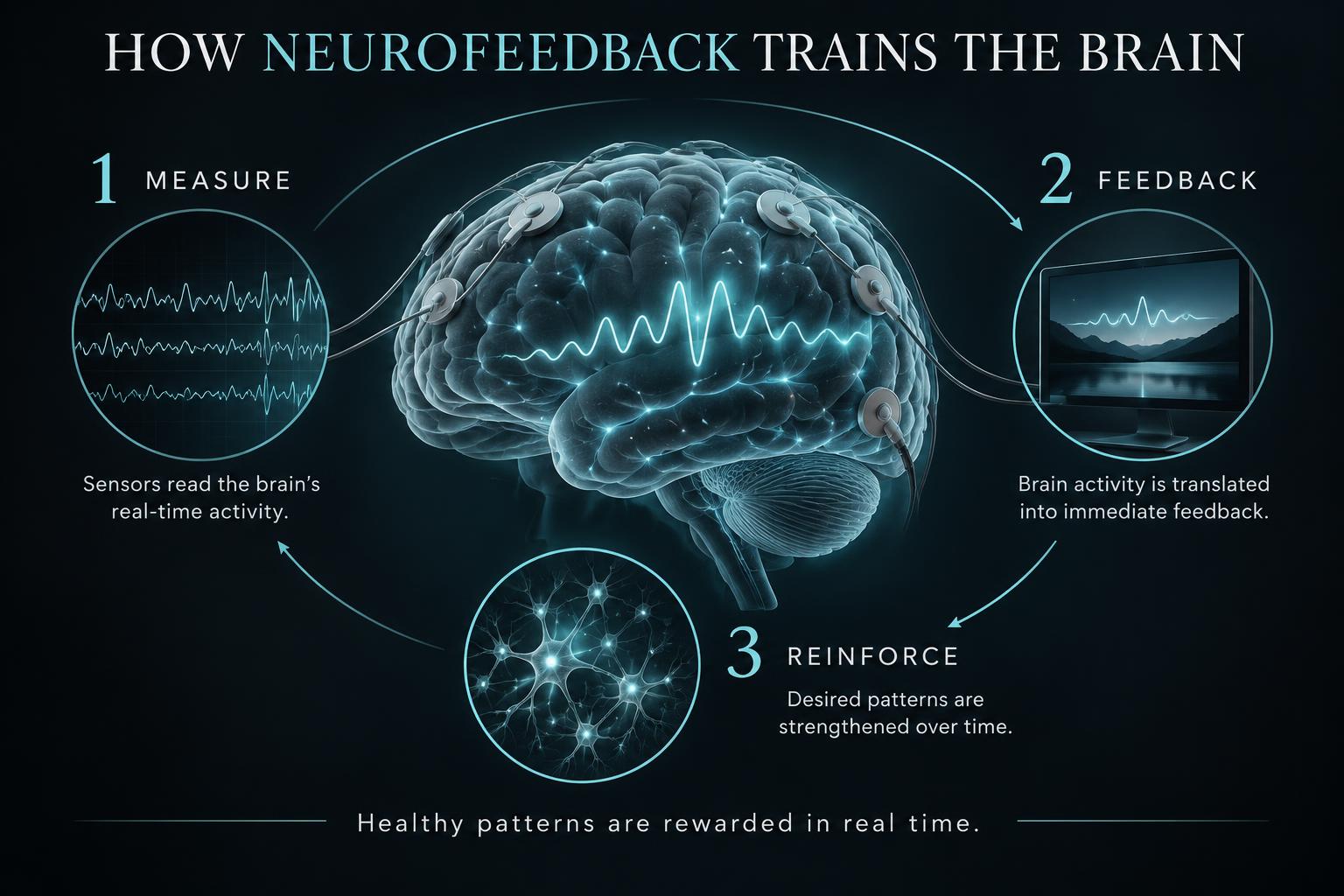
The American Psychological Association describes it this way: neurofeedback harnesses neuroplasticity — the brain's ability to reorganize itself by forming new neural connections. This is particularly valuable for TBI recovery, where damaged neural pathways need to be rehabilitated or rewired.
For TBI survivors, this neuroplasticity angle is everything. The injury disrupted the brain's internal communication highways. Neurofeedback doesn't repair the damage that was done — it helps the brain build new roads around it.
The Scale of the Problem
Traumatic brain injury is far more common than most people realize. It affects people of every age, background, and walk of life — athletes, veterans, accident survivors, and everyday people who hit their heads in ways that seemed minor at the time.
According to the CDC's TBI surveillance data, there were 214,110 TBI-related hospitalizations in the U.S. in 2020, and 69,473 TBI-related deaths in 2021 — averaging over 190 per day. Millions more are living with long-term TBI symptoms, many undiagnosed.
Behind every number is a person trying to get their life back. Standard rehabilitation — physical therapy, speech therapy, medications — addresses a lot, but it doesn't always touch the underlying dysregulation in brainwave activity that drives so many TBI symptoms. That's the gap neurofeedback is positioned to fill. Many survivors never get that far, because the injury itself was missed in the first place — a pattern we cover in depth in our article on TBI misdiagnosis.
What Neurofeedback Can Address After TBI
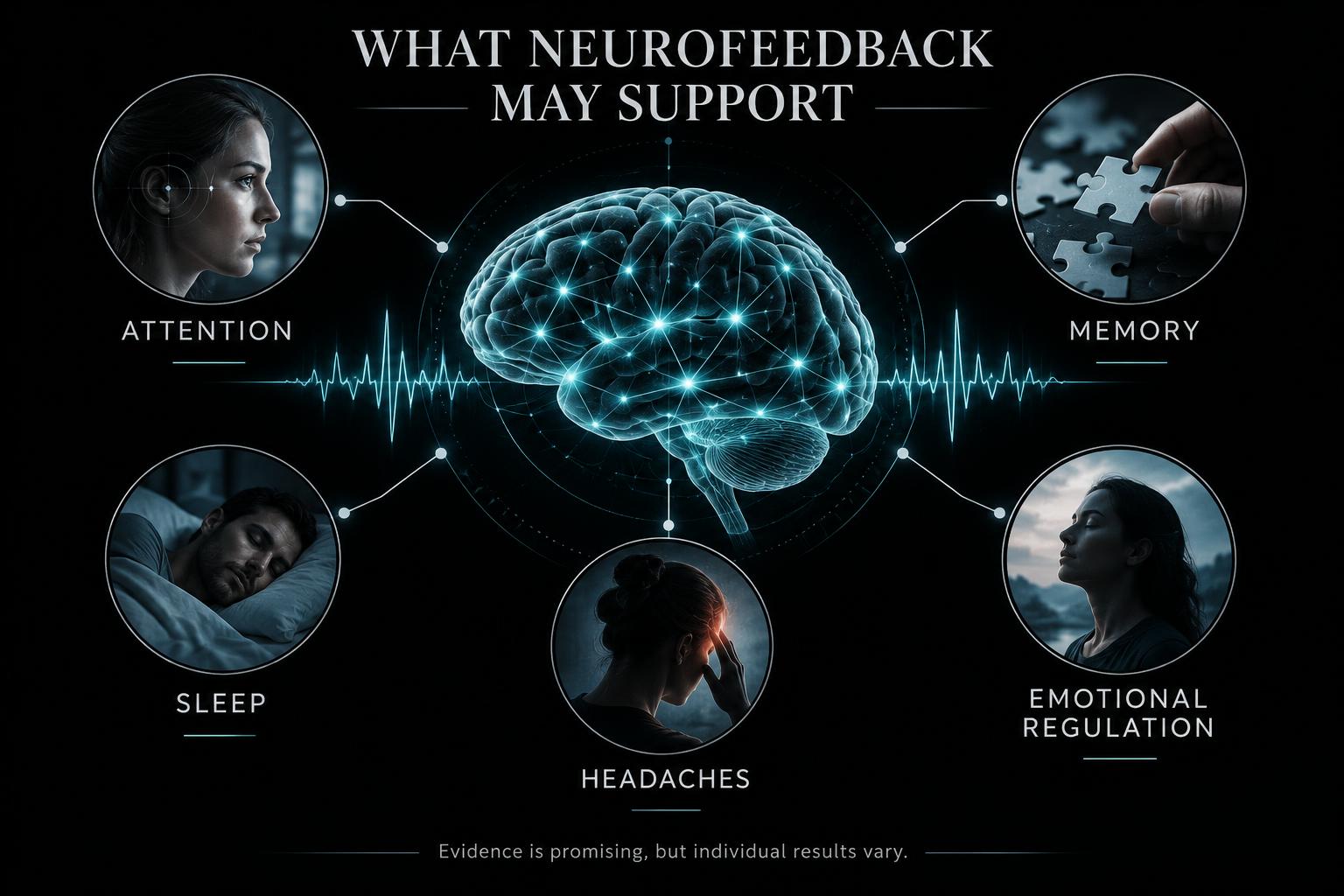
Research and clinical experience point to a wide range of TBI-related symptoms that neurofeedback may help improve.
Cognitive Function — Memory, attention span, and executive function are among the most reported improvements. Studies cite meaningful gains in working memory and sustained focus after 15–20 sessions.
Sleep Disruption — Neurofeedback trains the brainwave patterns that govern sleep cycles, which TBI commonly disrupts — helping survivors finally get restorative rest.
Headaches — By reducing tension and dysregulation in neural activity, neurofeedback training may lower the frequency and intensity of post-TBI headaches.
Mood & Emotional Regulation — Irritability, anxiety, and depression are common TBI companions. Training the brain toward calmer states has shown promise in helping survivors regain emotional steadiness.
Communication & Daily Functioning — In documented cases involving severe TBI, extended neurofeedback treatment correlated with measurable improvements in communication, grooming, feeding, and social connection.
Neurofeedback is one tool among several in the brain recovery toolbox, alongside nutrition, exercise, and supplement strategies — many of which are laid out in our free concussion and TBI recovery guides.
What the Research Shows
Neurofeedback's evidence base is still maturing, but the published findings are increasingly hard to dismiss. Full citations for the studies referenced below appear in Resources & Further Reading at the end of this article.
The Pilot Study — In a published pilot study of patients with mild TBI, 20 sessions of alpha-theta neurofeedback produced significant gains in working memory, sustained attention, and executive function — areas of daily life that TBI quietly devastates. The sample was small (17 patients) and uncontrolled, so the results are best read as promising rather than definitive.
A Landmark Case Study — A published case report describes a 33-year-old woman struck by a car and thrown 30 feet, resulting in a severe TBI and a seven-week coma. After intensive rehabilitation, she began a combined program of neurofeedback and hyperbaric oxygen therapy (HBOT) in late 2021. By early 2022 — just months in — her care team documented significant gains in cognition, sleep, conversation, emotional control, and relationships.
By December 2023, after 195 neurofeedback sessions, further improvements were recorded across every measure. A June 2024 quantitative EEG (qEEG) analysis confirmed the gains were neurologically real — not just reported. Objective disability scales showed improvements in feeding, toileting, grooming, and communication, all with statistical significance. Because this is a single case report rather than a controlled trial, it can't establish that neurofeedback caused the gains — but it does document, with objective measures, that meaningful recovery occurred long after the injury.
The authors' central observation is what makes the case notable: neurofeedback appeared to still produce measurable change many years after the original injury, suggesting the window for recovery may be considerably longer than the conventional "first six to twelve months" assumption. As always with case reports, this is one patient's trajectory, not a population-level finding.
Combined with HBOT — The research suggests that neurofeedback and hyperbaric oxygen therapy may work synergistically. HBOT increases oxygen delivery to injured brain tissue while neurofeedback trains the brain's electrical regulation. Used together, both the neurological substrate and the functional patterns are being addressed simultaneously. At Strength In Pain Foundation, HBOT is a therapy we've long advocated for, and we're paying close attention to how these two approaches may complement each other.
What a Session Actually Looks Like
A neurofeedback session is quiet, non-invasive, and typically painless. You sit in a comfortable chair while a technician attaches small sensors to your scalp. You watch a screen — often a movie or game — that responds to your brainwave activity in real time. When your brain produces a target pattern, the experience rewards you: the movie plays clearly, the game scores. When it drifts, the signal dims or pauses.
Sessions usually run 30 to 60 minutes. Most protocols recommend 20 to 40 sessions for meaningful change, though complex TBI cases may benefit from more. Progress is tracked through qEEG assessments — brain maps that show which regions are over- or under-activating and how patterns shift over time.
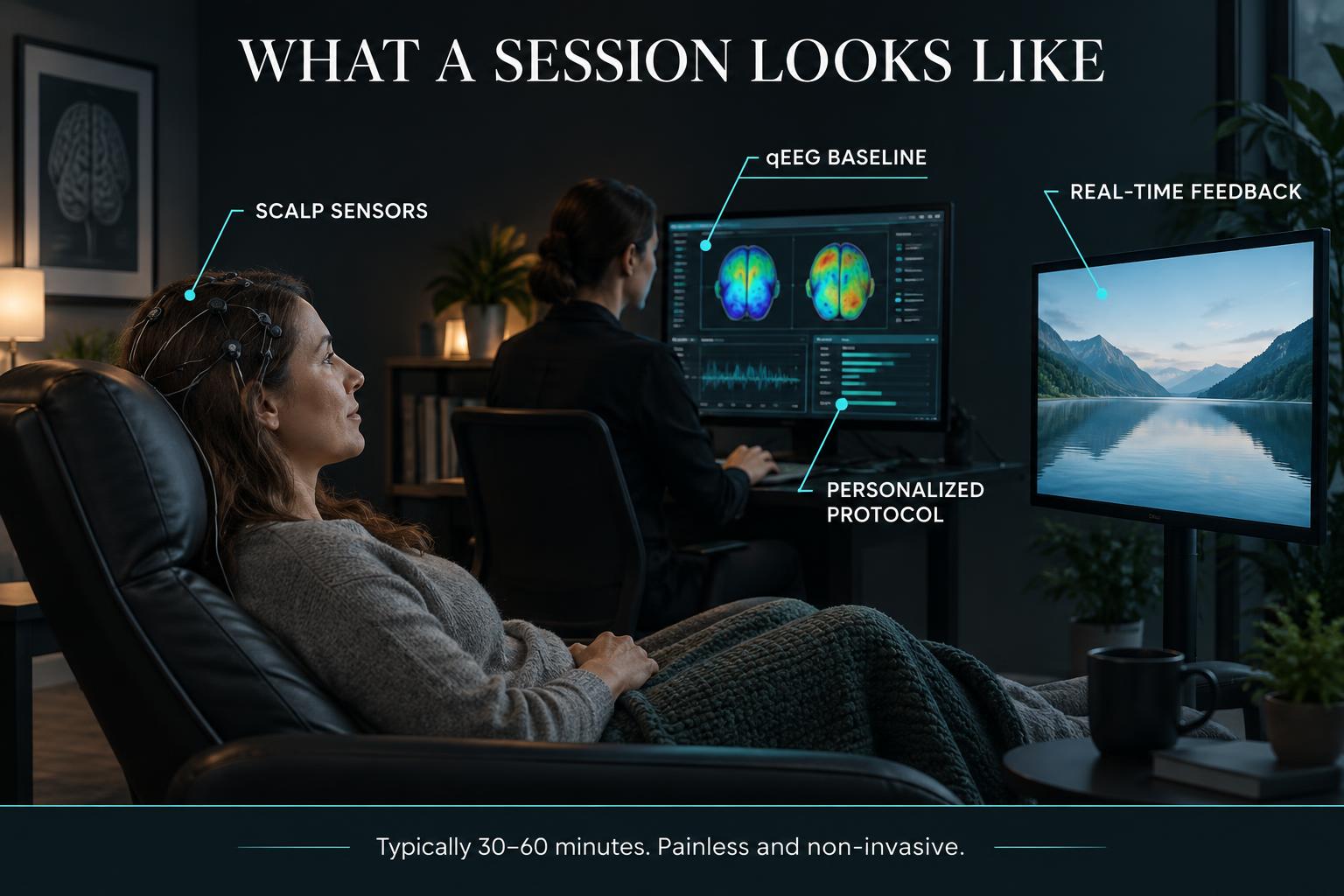
Not all neurofeedback clinics are equal. If you're exploring this therapy for TBI, look for practitioners with specific training in neurological conditions — not just general wellness applications. Ask whether the clinic uses qEEG mapping before beginning treatment. A personalized brain map should drive your protocol, not a one-size-fits-all approach.
Honest Caveats
We believe in giving our community an honest picture. Neurofeedback is promising — but it is not a cure, and results vary. The effectiveness depends heavily on the type and severity of the injury, the skill and experience of the practitioner, the consistency of the patient in completing sessions, and whether neurofeedback is integrated into a broader, comprehensive care plan. It is a tool, not a magic switch.
Research is also still catching up. Many studies are small or case-based. Larger randomized controlled trials are underway, and the field is advancing quickly — but we encourage every TBI survivor and caregiver to approach any therapy with informed optimism rather than blind faith.
A Word From Our Founder
"At Strength In Pain Foundation, we've seen firsthand how conventional care alone can leave survivors without answers. As someone who has personally navigated the aftermath of a concussion, I know the frustration of being told to 'just rest and wait.' Emerging therapies like neurofeedback give us something better to offer: agency, science-backed options, and hope grounded in real outcomes.
Our mission is to make sure survivors know these options exist — and to fight for access to them, especially for those without the financial resources to find them on their own. Neurofeedback is not yet widely covered by insurance. That's a barrier we intend to help dismantle."
— Bjorn Hazelquist, Founder, Strength In Pain Foundation
Next Steps If You're Interested
Get a qEEG Brain Map — This baseline assessment gives a certified practitioner a detailed picture of your brain's current activity patterns and informs a personalized protocol.
Ask Your Neurologist or Care Team — Neurofeedback works best as part of a comprehensive plan, not in isolation. Loop in your existing providers before starting.
Reach Out to the Foundation — If cost or access is a barrier, contact Strength in Pain Foundation directly. We work to connect survivors with resources, advocate for financial assistance for treatments not covered by insurance, and help navigate the landscape of emerging therapies.
FAQ: Neurofeedback for Brain Injury
Does neurofeedback work for traumatic brain injury?
The available evidence — small pilot studies, case reports, and clinical experience — suggests neurofeedback can improve memory, attention, sleep, headaches, and emotional regulation after TBI. It is not a cure, and large randomized trials are still needed, but the results reported so far are consistent and encouraging.
How many neurofeedback sessions does TBI recovery take?
Most protocols recommend 20 to 40 sessions of 30–60 minutes each for meaningful change. Severe or complex TBI cases often require considerably more — the documented case study above involved 195 sessions over roughly two years.
What does a neurofeedback session feel like?
Painless and uneventful by design. Sensors sit on your scalp while you watch a movie or play a game that brightens, plays, or scores when your brain produces the target pattern and dims when it drifts.
Is neurofeedback covered by insurance?
Usually not for TBI. Coverage is inconsistent and often denied as investigational, which is why many survivors pay out of pocket — and why the Foundation advocates for access and offers financial assistance.
Can neurofeedback still help years after a brain injury?
Published case evidence suggests yes. Measurable, qEEG-confirmed gains have been documented in a survivor beginning therapy years post-injury, which challenges the assumption that recovery stops after the first year.
Is neurofeedback better than HBOT for brain injury?
They target different problems and are often used together — HBOT improves oxygen delivery to injured tissue while neurofeedback retrains electrical regulation. Most clinicians working in this space treat them as complementary rather than competing.
How do I choose a neurofeedback practitioner?
Look for training in neurological conditions rather than general wellness, ask whether qEEG brain mapping precedes treatment, and confirm your protocol is individualized to your brain map.
Resources & Further Reading
TBI hospitalizations and deaths: Centers for Disease Control and Prevention. "Traumatic Brain Injury & Concussion: Data and Statistics." CDC, 2020–2021 surveillance data.
Alpha-theta neurofeedback pilot study: Reddy RP et al. "Neurofeedback training as an intervention in a silent epidemic: an Indian scenario." Journal of Neurotherapy, 2009 — 17 patients with mild TBI, 20 sessions, gains in attention, working memory, and executive function.
Neurofeedback and post-concussion symptoms: May G et al. "Neurofeedback and traumatic brain injury: a literature review." Annals of Clinical Psychiatry, 2013.
Combined neurofeedback and HBOT case report: published case documentation of a severe-TBI survivor treated with 195 neurofeedback sessions plus hyperbaric oxygen therapy, with qEEG and disability-scale outcomes recorded from 2021 to 2024.
Neuroplasticity and biofeedback overview: American Psychological Association, "Neurofeedback gains popularity and lab attention."
The information in this article is for educational purposes only and does not constitute medical advice. Always consult a qualified healthcare provider familiar with brain injury before beginning any treatment protocol.