I Have Memory Loss After My Brain Injury. Now What?
What Should You Do If You Have Memory Loss After a Brain Injury?
Start by taking it seriously, getting it properly evaluated, and building systems that do the remembering for you while your brain heals. Memory loss after a traumatic brain injury (TBI) is one of the most common symptoms survivors report, and it is not a sign that you're lazy, careless, or "losing it." It's a sign that the parts of your brain responsible for taking in, storing, and retrieving information were injured. Even after injuries labeled "mild," the problems often last longer than people are told to expect. In the landmark TRACK-TBI study, 53% of people with mild TBI still reported functional limitations 12 months after their injury, including many whose CT scans were completely normal.
The good news: memory problems after a brain injury are well studied, often improve, and respond to the right combination of strategies, rehabilitation, and treatment. This post walks through what's happening, what to expect, and exactly what to do next.
Why a Brain Injury Affects Memory
Memory isn't one thing stored in one place. It's a process that runs across several brain systems at once. The hippocampus and surrounding structures in the temporal lobes help turn new experiences into lasting memories. The frontal lobes handle working memory (holding information in mind for a few seconds while you use it), attention, and the organized search you do when you try to recall something. These regions sit near the front and sides of the skull, which is exactly where the brain tends to strike bone in falls, car accidents, sports collisions, and wipeouts.
A brain injury can also damage the long connecting fibers between brain regions. This kind of diffuse injury slows down how quickly information travels, and it rarely shows up on a standard CT or MRI. That's why so many survivors are told their scans look fine while they can't remember what they walked into the kitchen for.
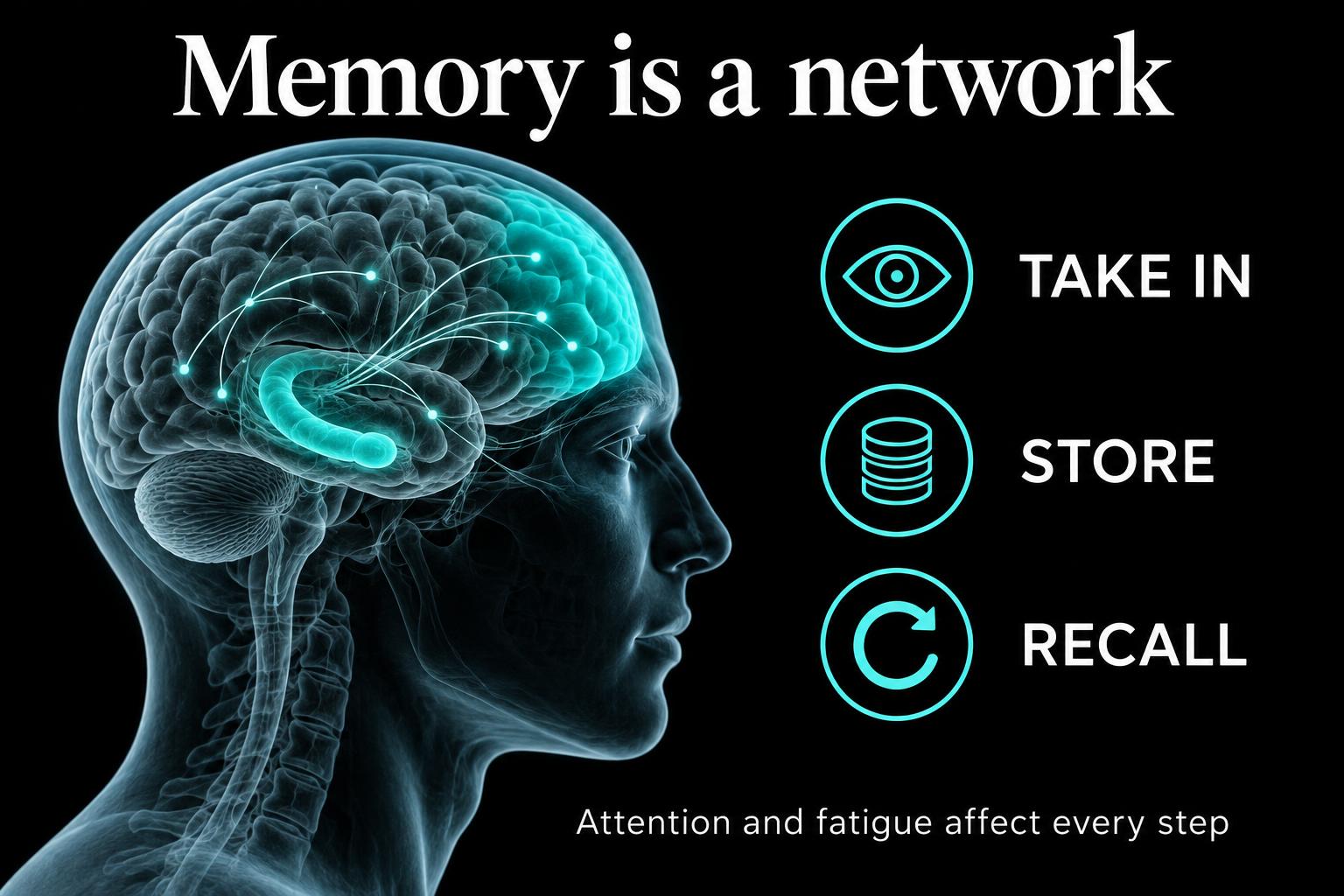
On top of the direct injury, three things make memory worse during recovery:
- Attention problems. You can't remember what you never fully took in. Many "memory" problems are actually attention problems at the front end.
- Neurofatigue. A healing brain burns through energy fast. Memory is often noticeably worse in the afternoon and evening than first thing in the morning.
- Poor sleep, pain, anxiety, and depression. All of these interfere with memory on their own, and all of them are common after TBI.
The Memory Problems Survivors Notice Most
Every injury is different, but these patterns come up again and again:
- Forgetting recent conversations or instructions. Older memories may be intact while new information doesn't stick.
- Losing your train of thought mid-sentence or mid-task, especially when interrupted.
- Prospective memory failures. Forgetting to do things in the future: appointments, medications, bills, picking someone up.
- Repeating questions or stories without realizing you've already asked or told them.
- Misplacing things constantly and having no memory of where you set them down.
- Word-finding trouble. The word is "right there" but won't come.
- Gaps around the injury itself. Many survivors have no memory of the moments, hours, or days before and after the injury (retrograde and post-traumatic amnesia). Those memories often don't return, and that's normal.
If you recognize yourself in this list, you are not alone, and none of it means you're failing at recovery.
Will My Memory Come Back?
For many survivors, memory improves significantly, especially in the first several months as swelling and inflammation settle and the brain begins to reorganize. But "most people recover in a few weeks" is an outdated message that leaves a lot of survivors feeling broken when they don't.
The research paints a more honest picture. In a TRACK-TBI analysis focused specifically on cognition, 14% of people with mild TBI had clinically meaningful cognitive impairment, decline, or both a full year after injury, compared with roughly 4% of uninjured people. After more severe injuries, memory tends to be the slowest domain to recover. A five-year study of people with significant TBI found that verbal memory remained impaired in 60% of patients at the five-year mark, even as other skills like general reasoning and simple attention largely recovered.
What this means for you: if your memory is still struggling months or years after your injury, you are not an outlier and you are not out of options. Persistent memory problems are a reason to look deeper, not a reason to give up.
When Memory Loss Needs a Deeper Workup
Get urgent medical attention right away if memory problems come with a worsening headache, repeated vomiting, confusion that is getting worse, slurred speech, weakness on one side, unusual drowsiness, or seizures. These can signal bleeding or swelling that needs emergency care.
For ongoing memory problems, these are signs it's time to push for a more thorough evaluation:
- Memory problems that haven't improved, or have gotten worse, after three to six months
- Problems that are affecting your job, finances, safety, or relationships
- A history of more than one concussion or head injury
- You were told your scans were "normal" but you clearly aren't functioning like yourself
A good next step is a referral to a neuropsychologist, who can run formal testing to pinpoint which parts of memory are affected and why. That testing turns a vague complaint ("my memory is bad") into a specific map that guides treatment. Ask your doctor about functional evaluations too. Structural scans show bleeding and swelling; functional tools like SPECT imaging and qEEG can show how the brain is actually working, and they often catch what standard imaging misses.
Strategies That Help Right Now
You don't have to wait for your brain to heal to start functioning better. The most effective approach is to stop relying on your memory to do jobs a tool can do.
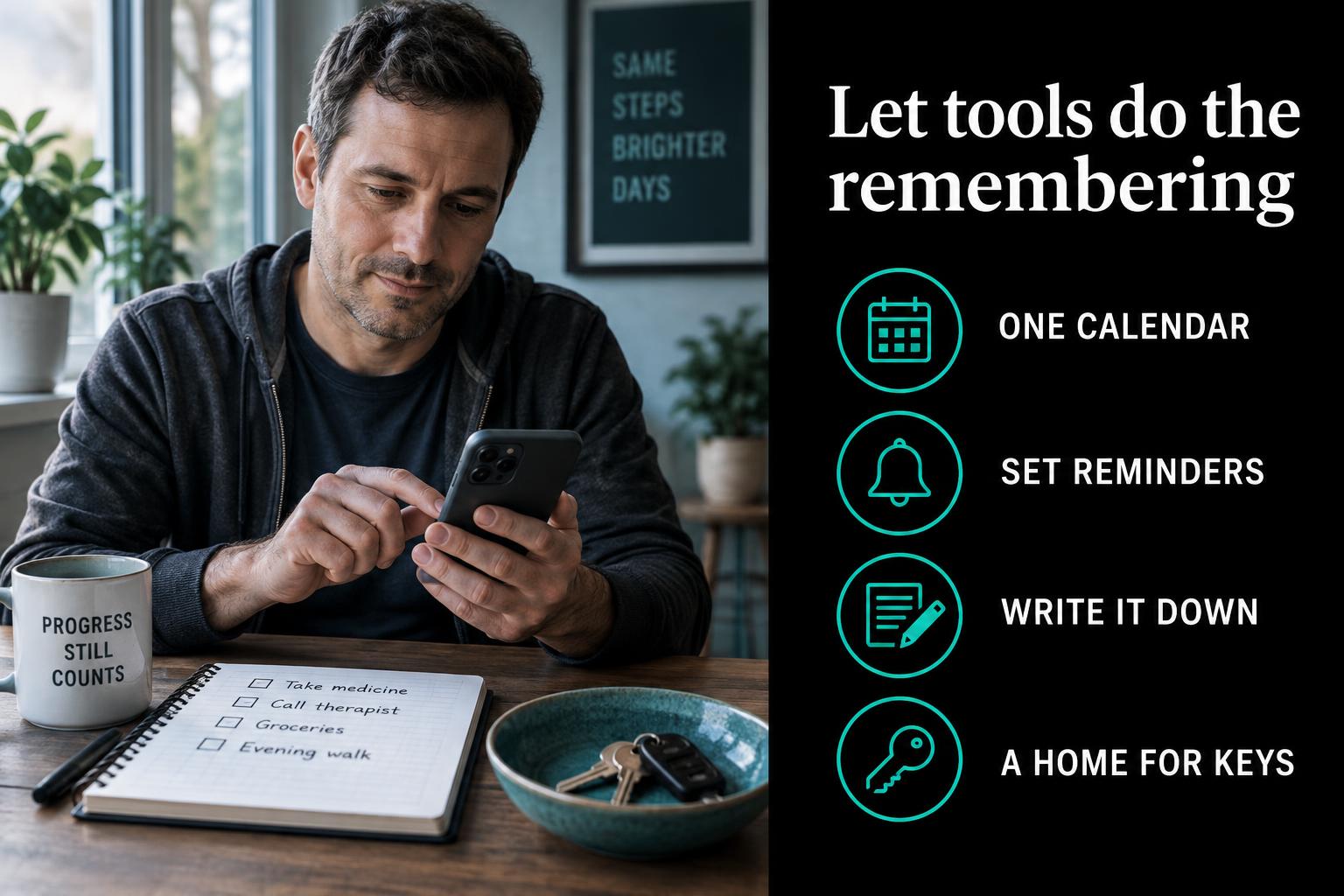
Use external memory aids, and use them every day. This is the best-supported memory strategy for brain injury survivors. A review of rehabilitation research covering 39 studies of paper-based and electronic memory aids found that every study reported improved memory functioning with their use. Practical examples:
- One calendar app with alarms for every appointment, medication, and deadline
- A single notebook or notes app that goes everywhere with you
- Phone reminders set the moment something is mentioned, not later
- Checklists for routines like leaving the house, cooking, or work tasks
Give everything a home. Keys, wallet, phone, and glasses go in the same spot every time. A bowl by the door eliminates dozens of daily searches.
Write it down immediately. Don't trust "I'll remember that." Capture it in the moment.
Reduce multitasking. Do one thing at a time, in a quiet environment when possible. Fewer distractions means more gets encoded.
Repeat and rehearse. Say important information back out loud, and review your notes at the end of each day.
Protect your sleep. The brain consolidates memories during sleep. Consistent sleep and wake times, a dark room, and limiting screens before bed all help.
Schedule demanding tasks early. Use your best brain hours for appointments, paperwork, and important conversations.
Move your body. Regular aerobic exercise, cleared by your doctor, supports blood flow and brain health during recovery.
Treatments Worth Asking About
Strategies help you work around memory problems. Some treatments aim to improve the underlying brain function itself.
- Cognitive rehabilitation. Speech-language pathologists and occupational therapists trained in brain injury teach memory strategies, set up aids that fit your life, and practice them with you until they stick.
- Hyperbaric oxygen therapy (HBOT). In a randomized trial of 56 people with lasting post-concussion symptoms one to five years after a mild TBI, HBOT was associated with improved cognitive function and quality of life, along with changes in brain activity on SPECT imaging. Research on HBOT for brain injury is still evolving, and results across studies have been mixed, but it's a reasonable question to raise with a provider who knows the literature.
- Neurofeedback. This EEG-based training helps the brain practice more regulated activity patterns and may support attention, focus, and sleep, all of which feed directly into memory.
- Treating what's making it worse. Addressing sleep problems, headaches, depression, anxiety, and medication side effects often produces real memory gains on its own.
We've written in depth about HBOT, neurofeedback, and SPECT imaging elsewhere on this site. Insurance often won't cover these treatments, and Strength In Pain Foundation provides financial assistance to help survivors access them. Reach out to us here if cost is what's standing between you and care.
Talking to Family, Work, and Your Care Team
Memory problems are invisible, which makes them easy for others to misread as not caring or not trying. A few things help:
- Tell the people closest to you what's going on. "My brain injury affects my memory. If I forget something, it's not personal. Texting me reminders really helps."
- Ask for things in writing at work and at medical appointments. Email summaries and written instructions are reasonable accommodations.
- Bring someone with you to appointments. A second set of ears catches what you might miss.
- Keep a symptom log. Note when memory slips happen, what you were doing, and how tired you were. Patterns show up quickly, and your care team can use that information.
If you're returning to work, our post on going back to work after a brain injury covers accommodations in more detail.

Frequently Asked Questions
Is memory loss after a brain injury permanent?
Not necessarily. Many survivors see significant improvement, especially in the first year. Some memory difficulties persist, particularly after moderate to severe injuries, but strategies, rehabilitation, and treatment can still improve day-to-day functioning long after the injury.
Can a mild concussion cause memory loss?
Yes. "Mild" refers to how the injury was classified at the time, not how much it affects you. In the TRACK-TBI study, more than half of people with mild TBI reported functional limitations at 12 months.
Why can I remember things from years ago but not what happened this morning?
Brain injuries most often disrupt the process of forming new memories, while older, well-established memories are stored more broadly and tend to be better protected. This pattern is very common after TBI.
Why is my memory worse at the end of the day?
Neurofatigue. A recovering brain uses more energy to do ordinary tasks, so attention and memory decline as the day goes on. Scheduling important tasks early and building in rest breaks helps.
What kind of doctor should I see for memory problems after a brain injury?
A neuropsychologist can formally test your memory and identify what's driving the problem. A neurologist or physiatrist (rehabilitation physician) can coordinate treatment, and speech-language pathologists and occupational therapists provide cognitive rehabilitation.
Do brain training apps help memory after a brain injury?
Evidence that general brain games improve everyday memory is limited. Practical external aids like calendars, alarms, and notebooks have much stronger support for reducing daily memory failures.
Can Strength In Pain Foundation help pay for memory-related treatment?
Strength In Pain Foundation provides financial assistance for specialized treatments that insurance often doesn't cover, such as HBOT and neurofeedback. Contact us to learn about next steps.
Sources
1. Nelson LD, et al. Recovery after mild traumatic brain injury in patients presenting to US level I trauma centers: a TRACK-TBI study. JAMA Neurol. 2019. https://pmc.ncbi.nlm.nih.gov/articles/PMC6547159/
2. Gardner RC, et al. Cognitive outcome 1 year after mild traumatic brain injury: results from the TRACK-TBI study. Neurology. 2022. https://pmc.ncbi.nlm.nih.gov/articles/PMC8967334/
3. Marsh NV. Cognitive functioning following traumatic brain injury: a five-year longitudinal study. NeuroRehabilitation. 2018. https://content.iospress.com/articles/neurorehabilitation/nre182457
4. The use of external aids in cognitive rehabilitation for memory impairment after acquired brain injury: a review. UCL Discovery. https://discovery.ucl.ac.uk/id/eprint/1354071/
5. Boussi-Gross R, et al. Hyperbaric oxygen therapy can improve post concussion syndrome years after mild traumatic brain injury: randomized prospective trial. PLoS One. 2013. https://pubmed.ncbi.nlm.nih.gov/24260334/
This article is for educational purposes only and is not a substitute for professional medical advice, diagnosis, or treatment. Always seek the guidance of a qualified healthcare provider with any questions about a brain injury or memory changes. If you experience sudden or worsening confusion, severe headache, repeated vomiting, seizures, slurred speech, or weakness after a head injury, call 911 or go to the nearest emergency room.