Recognize. Recover. Protect Your Brain.
Surfer's Concussion & Brain Injury Guide
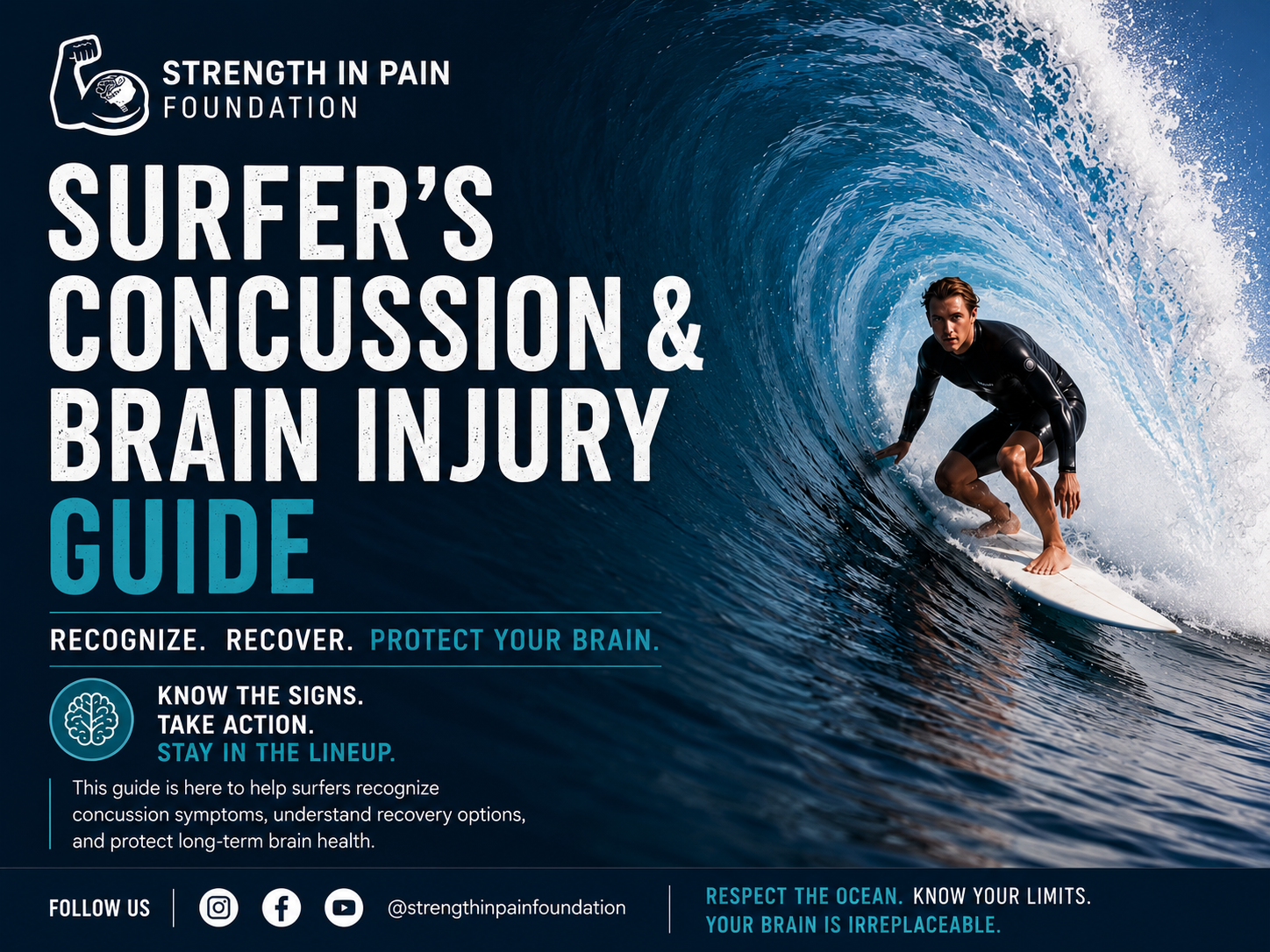
Surfing carries real head-injury risk — from your own board, from other surfers, from the reef, and from the raw force of the ocean itself. Most surfers never get a straight answer about what a concussion actually feels like, what to do in the first 24 hours, or when it is safe to paddle back out.
This guide from Strength in Pain Foundation walks through how concussions happen in surfing, the symptoms to watch for, a step-by-step recovery plan, the tools that may support brain healing, and a graduated return-to-surf progression. Read it here, or download the printable PDF to keep in your board bag.
How concussions happen in surfing
Concussions can happen anywhere, at any time. Surfing involves inherent risks, both from direct impacts and from the forces of the ocean.
- Board impact: Your own surfboard striking your head — the most common mechanism.
- Collision: Hitting another surfer, or being hit by their board, in a crowded lineup.
- Reef or bottom impact: Impact with the reef, rocks, or sand bottom during a wipeout.
- Wave hold-down: Being held under and tumbled by a wave.
- Violent wipeout: Being thrown around in heavy white water.
Contrary to popular belief, getting violently shaken by white water while duck diving or after a wipeout can cause a concussion or a sub-concussive injury — even with no direct blow to the head.
Repetitive impacts and the bigger picture
Research on how repeated smaller impacts affect the brain is ongoing, but minimizing repeated head trauma is smart. Repetitive sub-concussive impacts have been linked to post-concussion syndrome and, in contact sports, to chronic traumatic encephalopathy (CTE).
Returning to the water too soon after a concussion also risks second impact syndrome — a rare but serious complication in which a second head impact occurs before the brain has recovered from the first. Repetitive smaller impacts or violent shaking from wipeouts may contribute to brain stress over time. While some risk is unavoidable, surfers can take proactive steps to protect their brains and support long-term brain health: hydrate, eat clean, and prioritize rest and recovery. If you are heading into larger, more powerful waves — on a surf trip or during a big swell — some surfers use hyperbaric oxygen therapy (HBOT) before and after to support recovery and reduce inflammation.
Know the signs of a surfing concussion
If you or someone else shows any of these signs after a hit in the water, take it seriously and get out.
- Headache or a pressure feeling inside the head
- Dizziness, vertigo, or balance problems
- Confusion, or trouble finding words
- Nausea or vomiting
- Memory issues — not remembering the wave or the wipeout
- Sensitivity to light or noise
- Blurred or double vision
- Feeling generally "off"
- Loss of consciousness
When in doubt, sit it out. Never return to surfing the same day if you suspect a concussion.
What to do immediately after a suspected concussion
A simple plan can protect your brain and speed recovery. In the first 24 hours:
- Get a medical evaluation: Have a professional rule out a more serious injury.
- Rest your brain and body: Limit physical and mental exertion.
- Avoid alcohol, drugs, and caffeine: These can slow your recovery.
- Hydrate well: Drink plenty of water.
- Avoid another head impact: This is the single most critical step for recovery.
Over the next several days
- Follow medical advice — your provider guides your recovery.
- Gradually return to normal activities once you are symptom-free at rest and with light activity.
- Monitor symptoms, and seek help if they worsen.
- Limit screen time if symptoms are present.
- Be patient. Pushing too soon can set you back.
Post-concussion syndrome (PCS)
Some people experience symptoms that last weeks, months, or longer after a concussion. This is known as post-concussion syndrome. A concussion can cause temporary disruption in how brain cells communicate and how the brain uses energy, which affects thinking, mood, sleep, and daily function.
- Headaches or pressure
- Dizziness or vertigo
- Brain fog and trouble concentrating
- Memory problems
- Fatigue and sleep disturbances
- Irritability, anxiety, or depression
- Light and noise sensitivity
- Changes in mood or behavior
Persistent symptoms are real and treatable. Seek help if symptoms worsen or don't improve, headaches become severe or different than usual, you have confusion, slurred speech, or trouble finding words, or vision changes and light sensitivity get worse.
Brain recovery toolbox
Many tools may support recovery. Talk with a provider knowledgeable about brain injury to build a plan that fits you. The strength of evidence varies, and this list is educational — not medical advice.
- Sleep (strong evidence): Restorative sleep is critical for brain recovery and memory.
- Nutrition (strong evidence): Anti-inflammatory foods support brain repair and energy.
- Exercise (strong evidence): Improves blood flow, reduces fatigue, and boosts mood and cognition.
- Hyperbaric oxygen therapy (moderate): May support brain healing by reducing inflammation and improving oxygen utilization.Read: Oxygen Under Pressure — HBOT for brain injury
- Neurofeedback (moderate): Trains the brain to regulate itself and improve function.Read: Can Your Brain Retrain Itself? Neurofeedback for TBI
- Transcranial magnetic stimulation (moderate): May modulate brain activity and support neural recovery.
- Physical therapy (moderate): Supports balance, vestibular function, and neck health.
- Cognitive rehab (moderate): Strengthens memory, attention, processing speed, and problem-solving.
- Stress reduction (moderate): Meditation, breathwork, and relaxation calm the nervous system.
- Supplements and biohacking (moderate): Omega-3s, curcumin, magnesium, and other nutrients may support healing.Read: Natural supplements & biohacking for brain injury recovery
- Craniosacral therapy (limited): May support nervous system regulation and reduce imbalances.
- Emerging therapies: Research is ongoing on psychedelics, peptides, stem cells, and more.
Recovery is personal. What works for one person may not work for another. Work with clinicians who understand brain injury — a medical provider, physical therapist, mental health professional, nutritionist, or wellness coach can help you build and adjust a step-by-step plan.
Return to surfing safely: a graduated plan
Surfing is worth the wait. Move to the next step only when you are symptom-free at the current level. If symptoms return, go back to the previous step and give your brain more time.
- 1. Symptom-free at rest (24–48 hours): No symptoms at rest, with work or school, and with light exercise.
- 2. Light activity (1–2 days): Walking, gentle cardio, and basic bodyweight exercise.
- 3. Moderate activity (1–2 days): Increase intensity. Add surf-specific movements off the board.
- 4. Return to surf (2–3 days): Short, easy sessions in smaller surf with plenty of rest.
- 5. Full return (ongoing): Gradually return to regular surfing and more demanding conditions.
Tips for a safe return
- Choose smaller, cleaner waves and avoid heavy or crowded lineups.
- Keep sessions short at first — quality over quantity.
- Bring a buddy who can monitor you.
- Check in with yourself: how does my brain feel before, during, and after?
- Prioritize rest and recovery. Sleep is when healing happens.
Stop and contact a healthcare professional if you experience
- Worsening headache
- Repeated vomiting
- Seizures
- Weakness or numbness
- Slurred speech
- Extreme drowsiness, confusion, or agitation
- Loss of consciousness
- Any symptom that significantly worsens
Prevention: protecting your brain in the water
You can't control every wave, but you can control what you do to protect your brain. Smart choices in and out of the water lead to stronger sessions and a healthier future.
- Know your limits: Paddle out within your skill level and respect the conditions.
- Avoid reckless behavior: Big drops, heavy shorebreak, and risky maneuvers increase your risk.
- Look out for others: Help fellow surfers and communicate in the lineup.
- Take impacts seriously: Even if you feel fine, get checked after a significant hit. Scans can look normal even when a brain injury is real.Read: when TBI misdiagnosis delays care
- Track and learn: Keep a record of past head injuries. Each one matters.
- Helmets: Surf helmets are designed for water impact. Consider one in heavy or crowded conditions.
- Board choice: Choose the right board for your skill level and the conditions.
- Leashes: Use a quality leash and avoid wrapping it around your head or body.
- Lineup awareness: Position yourself where you can see what's happening and have an exit plan.This guide is part of our Surf Safety Advocacy program
A lifestyle that supports brain health
- Eat to fuel: whole foods, healthy fats, and antioxidants support brain repair.
- Stay hydrated — dehydration increases fatigue and slows recovery.
- Sleep well: deep, consistent sleep is when your brain heals.
- Manage stress with meditation, breathwork, and time in nature.
- Move your body — regular exercise improves blood flow, mood, and cognition.
- Get sunlight for vitamin D, mood, sleep, and overall brain health.
Final tips: stay strong, stay smart
Every wave is different, and every brain is different. Your brain is irreplaceable — treat it with care today and every day. Recovery takes time, and patience now leads to stronger sessions later. You know your baseline, so listen to your body and trust yourself. And you are not alone: support, community, and the right care make all the difference.
You can't stop the waves, but you can protect your brain. Surf another day.
Frequently asked questions
How do you know if you have a concussion from surfing?
Watch for headache or pressure in the head, dizziness, balance problems, confusion, nausea, memory gaps around the wipeout, sensitivity to light or noise, blurred vision, or simply feeling "off" after a hit. Symptoms can appear immediately or develop over hours to days. If you suspect a concussion, get out of the water, do not surf again the same day, and get evaluated by a medical professional.
Can a wipeout cause a concussion without hitting your head?
Yes. Being violently shaken or tumbled by white water, or held down by a wave, can generate the rapid acceleration and deceleration forces that cause a concussion or a sub-concussive injury, even with no direct blow to the head.
How long should you wait to surf after a concussion?
Never surf again the same day. From there, follow a graduated return: be symptom-free at rest for at least 24 to 48 hours, then progress through light activity, moderate activity, short easy sessions in small surf, and finally a full return. Each step takes roughly one to three days, and you should only advance while symptom-free. Get clearance from a healthcare professional experienced in concussion care.
What is second impact syndrome, and why does it matter for surfers?
Second impact syndrome is a rare but serious complication in which a second head impact occurs before the brain has recovered from a first concussion, causing rapid swelling. For surfers, this is the main reason never to paddle back out the same day and to follow a graduated return-to-surf plan with medical clearance.
Should surfers wear helmets?
Surf-specific helmets are designed for water impact and can reduce the risk of injury from board strikes, reef contact, and collisions. Many surfers consider them in heavy, shallow, or crowded conditions, and after a previous head injury.
What helps a concussion heal faster?
The strongest evidence supports restorative sleep, anti-inflammatory nutrition, hydration, and a gradual return to light aerobic activity once tolerated. Avoiding alcohol, recreational drugs, and any risk of a second impact is critical. Other tools such as hyperbaric oxygen therapy, neurofeedback, vestibular and vision therapy, and cognitive rehab may help some people; discuss them with a provider experienced in brain injury.
Keep going
Strength in Pain Foundation is a 501(c)(3) nonprofit supporting traumatic brain injury survivors. Explore our TBI support programs, brain injury financial assistance, treatment resources, and brain injury FAQ. If your brain injury was missed or misdiagnosed, share your experience in our survey.
This guide is educational and is not medical advice. It does not replace evaluation, diagnosis, or treatment by a qualified healthcare professional. If you are experiencing a medical emergency, call 911.